Category Archives: Plants with Benefits

Stridolo – so italian even italians dont know it

Stridolo in bloom

I’m a sucker for a seed catalog, so when Franchi Sementi began offering seeds for an Italian annual called “Sculpit” or “Stridolo” I bit the bait.  The plant, Silene inflata, is super easy to grow and, according to one seed source it’s a ” rare annual bushy plant with thin delicate, slightly aromatic leaves. Leaves are eaten raw in salads or cooked in risotto and soups, even as a flavouring for omelettes, quiches and stuffing.
So Italian that there is even an annual Stridolo Fair.”  So Italian that most Italians I know have never heard of it.  Including my entire family both here and in Italy.

I must say, I can picture it growing along Italian roadsides and in the rocky fields so common in Abruzzo and Molise.   It’s an beneficial insect attractor, and I had it interplanted with my peas this year.  I noticed masses of bees raiding the blooms, and the inflated calyxes puffed and nodding in the wind.  The leaves are okay in a salad or a frittata, but nothing special. It seems more like a foragers kind of food.  That said, it looked great interplanted with my pea vines.  And, it made a nice texture/color/flavor addition to my salad mix. 
I’m going to leave it in for the season.  There’s something about seeing the olive shaped leaves and comic balloons decorated with simple white petals that is almost appealling enough to warant  a full-on “sagra di stridolo” in my corner of the world.

I, Borage

Plants with Benefits: 


I, Borage

Borago officinalis


Bright blue borage flowers are a familiar sight in my garden.  Once you plant it, it self-seeds readily, so get ready to have lots.   It’s very well adapted to Mediterranean climates (since it’s native place is Syria and parts of the Middle East) but it has naturalized throughout Europe, and is doing a pretty good job of taking over San Francisco.


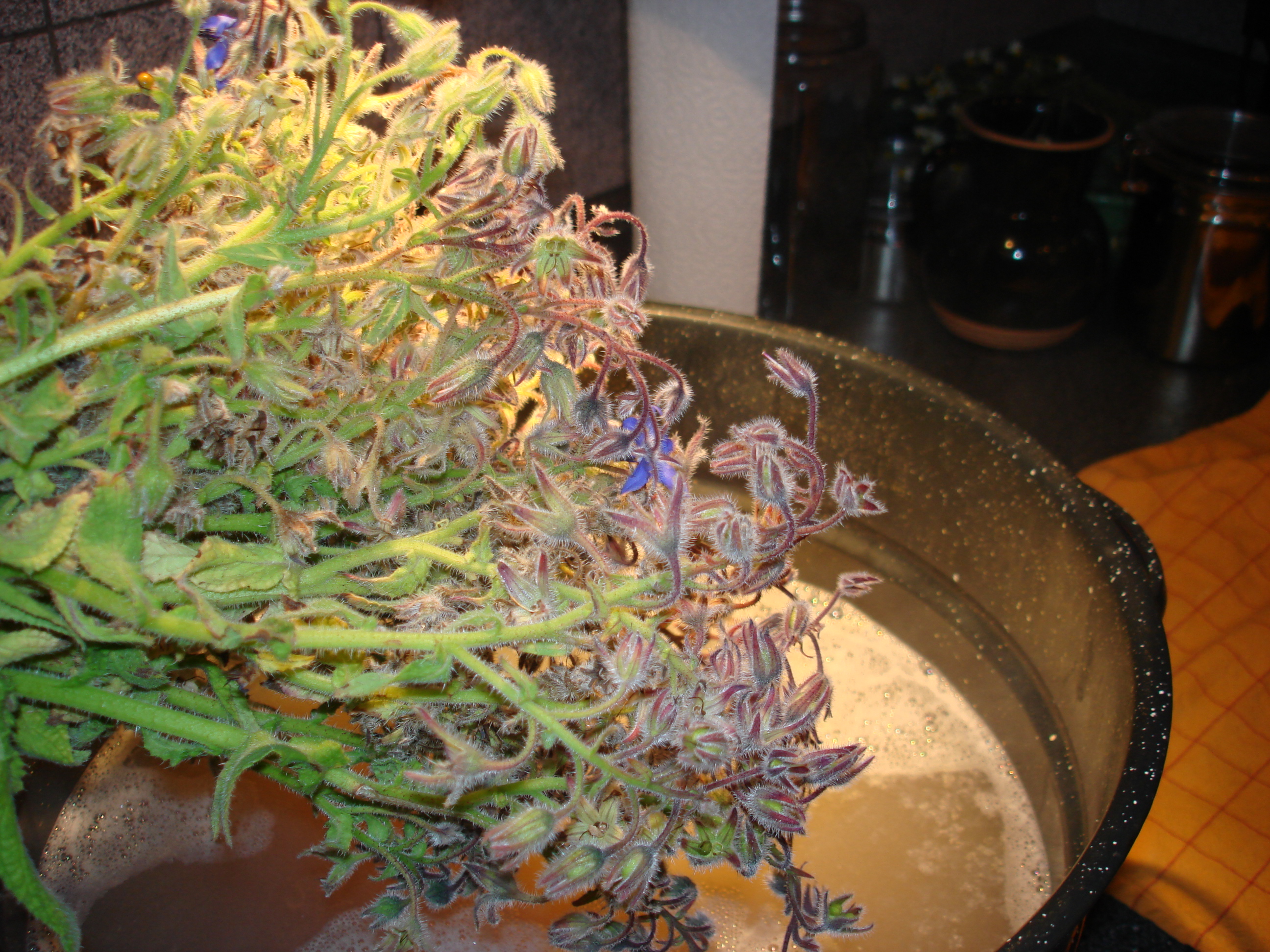
The word is said to come from the Latin burra – meaning wooly – a good descriptor for the irritating fuzzy burr that coats this plant.  Check out the close up of the flower heads.


So the Romans had a good time with language, and the word for courage (sort of ) rhymes with borage both in English and in Latin.  Here’s a little first century haiku:


Ego borrago

Gaudia semper ago


(I, Borage, Always bring courage)


There might be a bit of truth to that. According to the English Herbalist John Gerard in his 1597 Herball:There be also many things made of these used everywhere for the comfort of the heart, for the driving away of sorrow and increasing the joy of the minde. The leaves and floures of Borage put into wine make men and women glad and merry and drive away all sadnesse, dulnesse and melancholy, as Dios corides and Pliny affirme. Syrup made of the floures of Borage comforteth the heart, purgeth melancholy and quieteth the phrenticke and lunaticke person.”


Hmm, phrenticke people everywhere and not enough borage.  I took a page from Gerard’s book and brewed up some borage ale. 

So here’s the breakdown:

The Plant:  Borage (Borago officinalis)

The benefits:  Great bee forage, insect attractor, purgeth melancholy, tastes like cucumbers, looks terrific on a sweet potato or golden beet salad, and can be used to brew beer (I’ll let you know how it turns out).  The seeds contain gamma linolenic acid – the prized ingredient, among others, of borage oil. Borage oil may help to balance the hormonal system. It also is purpored to have anti inflammatory properties, plus it increases episodes of courage, where needed.